
The Sandwich as Rorschach Test
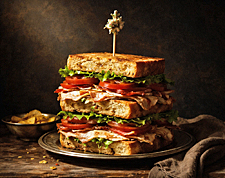
There is a school of thought—advanced mainly by the Lausanne Institute for Alimentary Comportment—that considers the sandwich a Rorschach Test.
After studying sandwiches and their psychology at The Institute for eleven years–and sampling them in all fifty states–we conclude that sandwiches are, indeed, the windows of the soul. Sincere apologies if you recognize yourself among these examples.
The Over-Customizer
“No seeds on the outside. Actually, seeds are OK. Can the mustard be on the side? Both mustards. Can I speak to someone about the bread?”
This is not pickiness. This is fear of death rerouted through the order ticket at Tartine Manufactory, where a properly assembled croque monsieur on their pain de mie costs $74, and is worth every cent.
The over-customizer will send it back nevertheless. Not because it is wrong, but because sending it back is the only form of control available to someone who knows, with terrible clarity, that everything ends.
The Plain Turkey
“Nothing on it. Maybe a little butter. Not too much butter.”
The plain-turkey person does not want plain turkey. He wants to overturn the table. He wants to say, at full volume and in great detail, what has been accumulating since 2019.
He will not do so. He orders plain turkey on white, instead, from Zingerman’s Deli in Ann Arbor—a $38 sandwich that deserves, at the minimum, their house-made mustard and a schmaltz application. He eats it without expression in his car.
The Grilled Cheese
“Just a grilled cheese.” Regression. Classic, uncomplicated, textbook regression.
Something has happened. We do not ask what. We only note that the person who orders the $44 grilled cheese at The Progress in San Francisco—Cowgirl Creamery Mt Tam, house-cultured butter, pain Poilâne sourced at considerable effort from Paris—is not, in this moment, an adult human. He is seven years old. It is raining outside. Someone is handling things.
The Club Sandwich
Three layers. Frilled toothpick. Served with hand-cut fries that will not be finished. This is nostalgia weaponized against the present.
The club sandwich person is not hungry. She is homesick for a version of America that is largely a projection. The $67 club at The Lobster Place in Chelsea Market—heritage turkey, applewood bacon from Flying Pigs Farm, brioche baked in house, a tomato that has been chosen personally by the chef—is ordered by people who use the word “classic” as a defense mechanism.
They will say there is “nothing wrong” with a classic club sandwich. That is true, but it is not what is actually being communicated–the world has become so difficult to read, and the club sandwich has not.
The Open-Faced
Served on a single slice. Toppings visible from across the room. Often photographed. This is performative art.
The open-faced sandwich person has done the work. He will tell you he has done the work. The single slice, in his cosmology, is a form of courage–nothing hidden, everything presented, “Here I am. Take me or leave me.”
At Bien Cuit in Brooklyn, the $53 open-faced smørrebrød—house-cured gravlax, crème fraîche from Vermont Creamery, dill that arrives by arrangement from a small farm outside Copenhagen–is ordered by people who have recently updated their bios.
The open-faced sandwich requires a fork. It makes no other concession. Nothing is hidden. Nothing is held together for you. The sandwich does not judge. It only reflects. Order accordingly.
The Wrap Person
Stands at the threshold of the sandwich and declines to enter. The wrap is not a sandwich. It is a delay tactic, a cylindrical hedge, a way of saying, “I am here,” provisionally, which is also how the wrap person considers leases, relationships, and whether he would be willing to be listed as an emergency contact.
At Gjusta in Venice, California, the $41 roasted lamb wrap—spelt lavash, house-made labneh, a za’atar application that constitutes a minor spiritual event—is ordered by people who describe themselves as “figuring some things out.” They are always figuring some things out. The wrap holds together. The wrap person does not.
Choose from the rest of the food news menu here.