Some Roadside Memorials Now Require Zoning Approval
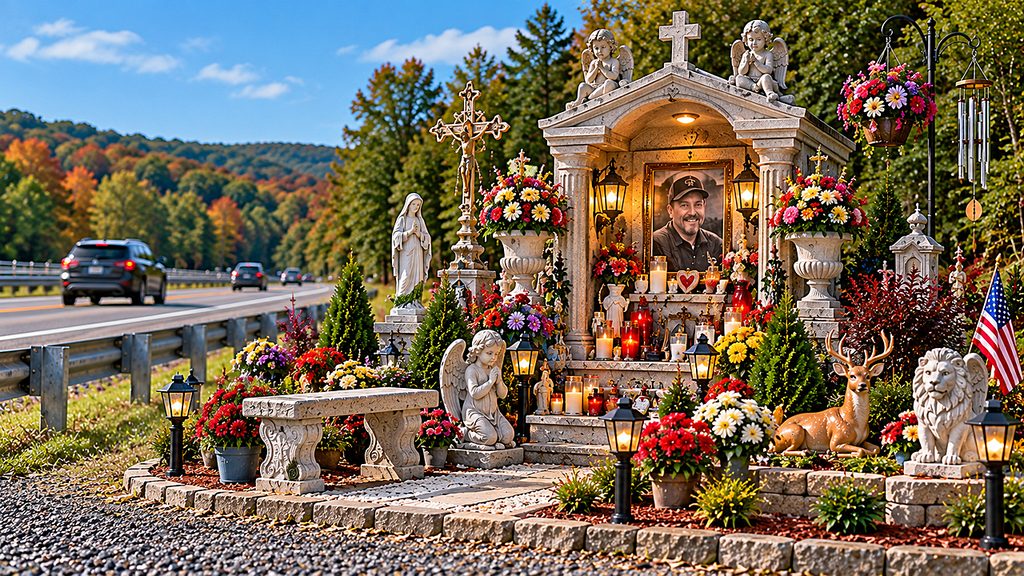
Pennsylvania transportation officials have enacted regulations for roadside memorials after determining that many have expanded beyond flowers and wooden crosses and are now technically improvements to the adjecent property.
The Pennsylvania Department of Transportation (PennDOT) said the traditional roadside memorial once consisted of a small cross, several bouquets, and perhaps a photograph protected by a plastic sleeve. That model is apparently becomimg obsolete.
“We’re seeing solar lighting, benches, landscaping, wind chimes, and seasonal decorations,” said Raymond Pescatore, 58, a retired commercial flooring estimator who owns four levels but trusts only one of them. “There’s one memorial outside Stroudsburg that puts up Christmas lights.”
Officials became concerned after an inspection of Route 209 discovered what investigators described as a “mini-mausoleum” occupying approximately thirty-two square feet of state right-of-way.
The structure featured granite facing, two Doric columns, six solar-powered votive candles, a stone angel, artificial hydrangeas, a scrolling lighted, message board, and a weatherproof guest book containing forty-seven signatures. Someone had also spread mulch.
“That’s usually when we get involved,” said Denise Wroblewski, 46, a PennDOT roadside compliance officer who can identify twelve varieties of decorative gravel from a moving vehicle. “Flowers are grief. Mulch indicates long-term planning.”
PennDOT has responded by establishing the Roadside Bereavement Architectural Review Board, which will determine how far a memorial may go before it becomes real estate.
Under preliminary guidelines, crosses, photographs, and bouquets would remain unrestricted. Memorial benches would require approval. Fountains, gazebos and permanent electrical service would require zoning variances.
The proposal has angered some families, who argue that roadside memorials provide comfort and should not be subjected to government interference.
PennDOT says it has no intention of restricting grief. “We get it that these memorials are important,” Wroblewski said. “We just need to know when somebody plans to pour a foundation.”
The department finally issued its first removal order after discovering that a roadside memorial erected eleven years ago had acquired landscaping, a paved walkway, two Adirondack chairs, and its own trash collection.
County officials had recently assessed the memorial at $184,000.
Read more life-changing dispatches from a culture officially in decline by clicking here.