
Stephen Hawking and His Big Bang Seduction Theory
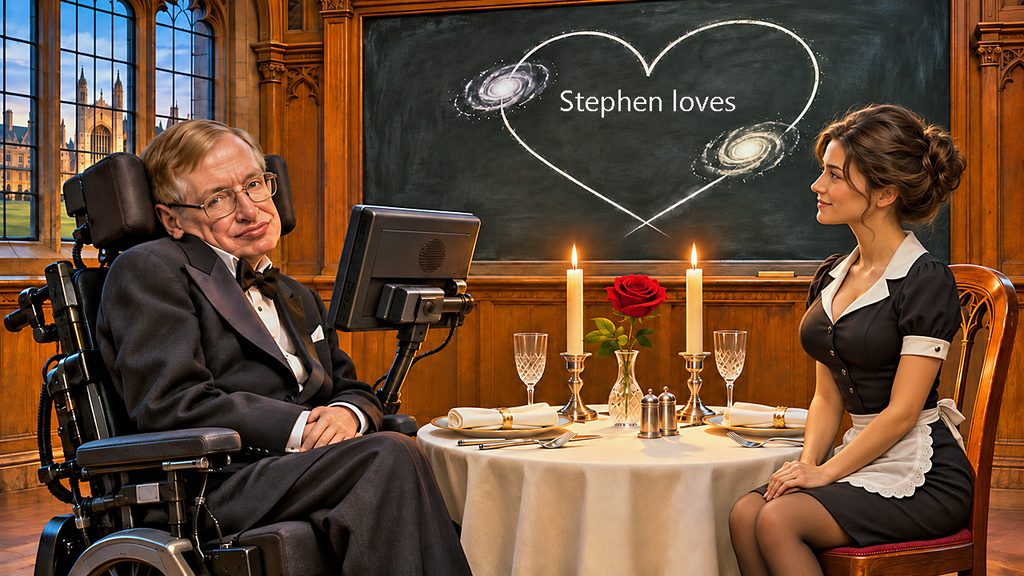
For decades we were told that Stephen Hawking spent his days pondering black holes and infinity. Apparently we should have asked what he had planned for evenings.
Graham Farmelo’s authorized biography, Hawking: His Life and Work, invites us to reconsider a man whose public image suggested he had transcended earthly concerns, when in reality earthly concerns had scribbled censored material all over his whiteboard in permanent marker.
Farmelo’s great service is bringing Hawking back down to Earth, where the heating bills and the marriages actually happened.
First came Jane Wilde, who married Hawking in 1965, raised their three children, and helped sustain the life from which his celebrated work emerged. The universe was expanding, he said. Jane would have appreciated someone taking out the trash.
Next came Elaine Mason, one of his nurses. They married in 1995, giving “round-the-clock care” a broader interpretation than most insurers recognize.
At this point the reader would be forgiven for demanding information that respectable biography is poorly equipped to supply. What was Hawking’s favorite mood music? For the bedroom scenes this review is imagining, Barry White backed by the Cambridge faculty humming gravitational waves.
His cologne would be Singularity: notes of sandalwood, hot chalk, and the faint suggestion that your husband is immaterial.
And his tattoo? Farmelo is discreet, but one must assume it exists. Small, tasteful, just above the left hip: E = mc², except the 2 is smudged from too much enthusiastic peer review. Or possibly, in a fit of youthful rebellion, Event Horizon: No Return in gothic script, which is either a physics joke or a very confident statement about his stamina.
And threesomes? The biographical record need not answer for the reviewer’s imagination. In the hypothetical Hawking version, three bodies enter a bedroom, six postgraduate students occupy the hallway with clipboards, and nobody gets tenure until the positions have been independently verified. By morning one participant has become purely theoretical.
The role-play, one imagines, was rigorous. On Tuesdays, his partners dressed as nuns, because nothing says “forbidden” like a woman who has taken a vow of chastity while operating a wheelchair joystick with two hands. On Fridays, they dressed as cocktail waitresses, because even a man who has explained the beginning of time likes to be asked, “And what can I do for you, Professor?”
Hawking once told New Scientist that women were what he thought about most: “They are a complete mystery.”
It is a splendid answer from a man who could contemplate the beginning of time yet apparently remained baffled by the words “We need to talk.”
There is something almost touching about that. Give a physicist billions of galaxies and he can establish a working model. Give him one disappointed woman at breakfast and suddenly more research is required. More funding. A larger team. A small conference in Tenerife.
Farmelo has undertaken the difficult business of restoring a human being to a reputation that had become practically celestial. The result leaves room for scientific greatness, domestic exhaustion, vanity, desire, and the suspicion that even the theory of everything would have benefited from a second bathroom.
Four stars. Hawking would have asked if two of them were seeing anybody.
Want more digital blasphemy? Fill your boots at technological mayhem.