Book of Daze: Lock Your Door Day
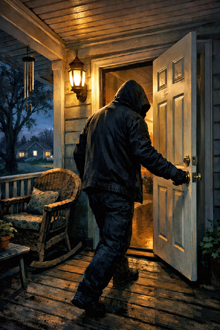
Lock Your Door Day traces its roots to a small, unnervingly quiet town in the Midwest where nothing bad ever happened, until something did.
Many people who live in small towns will tell you, with visible pride, that they never lock their doors. They say it the way other people say they have never needed glasses, as though the world has agreed to behave itself out of consideration for them. “If someone wants to get in, they’re going to get in anyway,” they argue, confusing a locked door with a philosophical position.
The house sat back from the road, porch light on, door unlocked in the name of community values. Inside, a man watched television until he fell asleep, secure in the belief that crime was something that occurred elsewhere, in cities with complicated parking.
Not long after midnight, someone entered the house without knocking. There was no broken glass, no splintered frame, no cinematic warning that the evening had taken a wrong turn. The door opened easily, because it always did.
What followed was the sort of event that later gets described in hushed tones on true crime programs, with phrases like “no sign of forced entry” or “the suspect may have simply walked in” or “maybe the victim knew his killer.”
By mid-morning, the town had acquired both a tragedy and a new vocabulary. Words like “random,” “unthinkable,” and “we never imagined” were used with a confidence that suggested imagination had never been part of the local toolkit.
Within a month, virtually every house on that street had a lock. Most of them even used. Thus was born Lock Your Door Day, a holiday dedicated to acknowledging that optimism is not a security system.
Americans have a touching faith in doors as decorative objects: About 17% of people admit they do not lock their front doors while at home. Roughly 25% of burglars simply walk in through an unlocked door. Translation: a meaningful percentage of crime begins with someone testing a doorknob like a polite vampire. Burglars, it turns out, are not masterminds. They are shoppers. If your house opens, it is open for business.
To Observe Lock Your Door Day locate your front door. It is the large, obvious weakness in your home’s defensive strategy. Turn the lock. This is the entire ritual. Resist the urge to complicate it.
For added observance, lock your back door as well, in a bold rejection of narrative symmetry. Spend the evening not being the opening segment of a documentary narrated by someone with a soothing British accent.
Small towns do not lack crime. They lack imagination about crime. Lock Your Door Day exists to bridge that gap, one quiet, deeply preventable tragedy at a time.
Browse the full Book of Daze