More Restaurants Banning Cell Phones
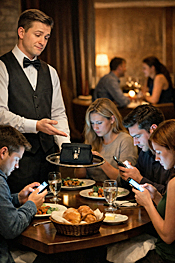
The modern dining experience has entered a corrective phase with more restaurants banning cell phones than ever before. Their move is a reaction to the fact that diners have spent years photographing appetizers that wound up tasting like obligation. Thus, a growing number of restaurants are asking diners to put their phones away, sometimes gently, sometimes with the quiet menace of a locked pouch.
At Antagonist, a cocktail bar in Charlotte, guests surrender their phones as if entering a low-security meditation retreat with better lighting. At Delilah, an upscale supper club in Denver, the rule is simpler: no phones, no posting, no evidence that you were ever there. Chick-fil-A, never one to miss a moral opportunity, is offering free ice cream to families willing to keep their phones off the table, a transaction that feels less like hospitality and more like a behavioral experiment.
Industry professionals insist this is not an anti-phone stance. “Guests are going out less often and spending more when they do,” said Ben Tannenbaum, a nightlife executive, explaining the policy with the calm tone of a man describing controlled burns. “Operators want to ensure the experience delivers.” Translation: if you spend $94 on a tasting menu foam, you will experience it, not document its decline into room temperature.
Experts agree the no-phone benefits are profound. Amanda Belarmino, a hospitality professor at UCLA, notes that diners who are not scrolling are more likely to order additional courses, which suggests that human connection is best achieved through incremental spending.
Other observers point out that food tastes better when it is consumed before becoming a still life.
Etiquette specialists have also weighed in, reminding the public that ignoring the person across from you in favor of a glowing rectangle sends a message. Historically, that message was conveyed through silence, passive aggression, or marriage. Now it is delivered via notifications.
Not surprisingly, enforcement remains awkward. Servers must approach tables like minor diplomats, requesting compliance from people who have not looked up since the bread arrived.
Some diners report a vague anxiety, a sense that something important is happening elsewhere, possibly involving strangers.
Still, there are signs of progress. In one Manhattan restaurant, two patrons were observed making direct eye contact for nearly three seconds. Neither reached for a device. Both later described the experience as “intense,” but admitted the meal was memorable, if only because it occurred entirely in real time.
Choose from the rest of the food news menu here.