
Foods Must Now Disclose Their Emotional Side Effects
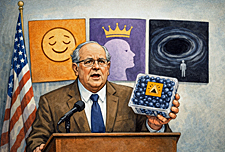
The Food and Drug Administration announced today that all edible products sold in the United States must now carry side effects labels describing a food’s emotional “mood‑forward properties.” These are defined as any emotional, psychological, or metaphysical state statistically associated with consumption.
The announcement was made in Silver Spring, Maryland, where officials unveiled the new standardized label: a stark white rectangle listing calories, allergens, and now “Emotional Outcomes,” ranked from Mild to Catastrophic.
“Consumers deserve to know whether a snack will trigger wistfulness, hubris, or a sudden awareness of the void,” said Deputy Commissioner Harold L. Munsen, who spoke while holding a carton of blueberries labeled May Induce Unfounded Optimism.
Early examples of compliant packaging have already appeared in regional markets. A tub of vanilla yogurt in West Chester, Pennsylvania, warns that it “May Cause Nostalgia For Events That Did Not Occur.” A bag of baby carrots distributed throughout the Mid‑Atlantic region carries the advisory “May Produce Short Bursts Of Moral Rectitude.” Frozen pizza, long suspected of emotional volatility, must now disclose its full spectrum: “May Cause Cosmic Futility, Resigned Acceptance, or Brief Heroism.”
Other products have proven more complex. In Portland, Oregon, a kombucha manufacturer has been required to list twelve separate mood states, including “Unrequested Clarity,” “Mild Superiority,” and “Transient Disdain for Furniture.” In the Upper Midwest, a popular brand of canned chili now includes the warning “May Trigger Frontier Melancholy.”
Industry representatives have expressed concern. “We support transparency,” said Lydia Corcoran, spokesperson for the National Snack Council, “but it is difficult to quantify the emotional impact of kettle‑cooked chips. Some individuals experience triumph. Others experience regret. A small percentage experience both simultaneously.”
Consumers, however, appear ready for the new labeling. “It is helpful to know that my sourdough loaf may cause a sense of historical grievance,” said Philadelphia resident Marcus Ellery, who described himself as “emotionally gluten‑curious.” A shopper in Des Moines praised the new system after discovering that her preferred brand of granola bars carried the advisory “May Produce Unfounded Confidence in Personal Scheduling.”
The FDA has indicated that enforcement will begin immediately, with particular attention paid to foods marketed as “artisanal,” “heritage,” or “chef‑driven,” categories that historically produce elevated levels of emotional turbulence.
Choose from the rest of the food news menu here.