
Tips for Preparing for a Nuclear Stress Test
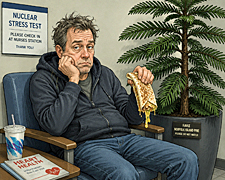
Patients preparing for a nuclear stress test are advised to bring books, snacks, puzzles, sensible clothing, and a realistic understanding of time.
According to the Mid-Atlantic Cardiac Imaging Pavilion, located in Camden, NJ, this guidance was implemented following years of complaints from patients who entered stress tests believing they had signed up for “a routine procedure” and only to find themselves sitting beside a plastic Norfolk Island Pine at 11:40 a.m., holding a limp crunch wrap and reconsidering several life choices.
“The actual testing portion lasts relatively few minutes,” explained Denise Halloran, 54, senior nuclear imaging technician and the owner of a heavily annotated copy of TheSeven Habits of Highly Effective People she has yet to complete.
“The rest is mostly waiting. We encourage patients to bring something calming: a novel, a crossword puzzle, or the ability to detach emotionally from clocks.”
Halloran confirmed that patients are free to bring snacks, provided they avoid “anything fragrant enough to become the dominant personality in the room.”
Among those preparing for a nuclear stress test was Leonard Vick, 67, a retired insurance adjuster from Wilmington, DE, who packed almonds, a turkey club sandwich, and a paperback history of the Crimean War “because if I’m going to experience extended boredom, I prefer thematic consistency.”
Another patient, Carla Mendes, 43, an AKC dog handler, arrived with herbal tea, compression socks, and three episodes of a Scandinavian murder series downloaded onto her Samsung tablet.
“At a certain point,” she said, “you stop wondering whether you have heart disease and start wondering if the vending machine has always made that noise.”
Hospital administrators maintain the lengthy process is medically necessary and not simply an elaborate demonstration of the collapse of linear time inside healthcare facilities.
“We monitor blood flow to the heart very carefully,” said Dr. Aaron Pritchard, 51, director of noninvasive cardiology and the owner of a facial expression that suggests he has delivered difficult parking instructions all his life.
“There are interviews, injections, scans, resting intervals, measurements, re-scans. Precision matters.”
Pritchard added that the newer open-design imaging equipment significantly reduces claustrophobia compared to older machines, which he described as “essentially a medically sanctioned panic cylinder.”
At press time, several patients in a clinic waiting area had already formed a loose emotional alliance based on shared charger access and mutual resentment toward the phrase “just a few more minutes.”
Want more digital blasphemy? Fill your boots at technological mayhem.