What Your Charcuterie Board Is Missing
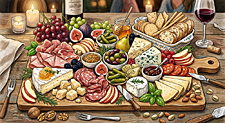
A charcuterie board is a personality assessment delivered horizontally, communicating in the universal language of cured meats and their concomitants that its architect has taste, intentionality, and at minimum two subscriptions to food content that arrives in linen-colored envelopes.
The traditional charcuterie arrangement adheres strictly to rules that are no less binding for being unwritten. Meats fan counterclockwise from the upper right. Cheeses anchor the corners like structural members. The honeycomb, which costs eleven dollars and will be largely ignored, occupies the spiritual center. Garnishes — the rosemary sprig, the grape cluster, the cornichon no one will eat — are distributed according to principles that merge feng shui with the golden ratio to produce a result that looks effortless precisely because it took forty-five minutes.
Yet no matter how artfully you have arranged the prosciutto and the Iberico ham. No matter that you sourced the manchego from a shop where the staff uses the word “provenance” without irony.
No matterhow much love you employed in arranging the honeycomb, the cornichon, and a rosemary sprig. Or that all of this is deployed on a board ideally reclaimed, ideally heavy, and ideally suggesting that somewhere upstream a barn was involved.
Still, something is missing. Something is keeping your charcuterie board from soaring. Food scientists, board architects, and at least one Substack writer with 44,000 subscribers know what it is.
Truffle butter. Not truffle oil, which is to truffle butter what a rain poncho is to a Burberry trench coat. Not truffle salt, truffle aioli, or any product that merely invokes the truffle from a respectful distance. Truffle butter.
Specifically, a half-teaspoon, no more, applied with a small offset spatula to the inner surface of your serving board before the cheese makes contact. This creates what culinary researchers at the Napa Institute for Board Integrity call a “flavor undercarriage” that elevates the tasting experience by forty percent.
“Boards that omit the truffle butter are communicating something to their guests,” said Marcella Dinwoody, a board consultant based in Scottsdale whose client list is confidential but whose waiting list is not.
“They are communicating that this is fine, but fine is not a destination. Fine is where flavor goes to accept its circumstances.”
The truffle-butter research supports her. A 2023 white paper published by the Journal of Assembled Provisions tracked guest satisfaction across four hundred boards in the greater Sedona area and found that truffle butter increased perceived host sophistication by twenty-eight points on a scale whose upper limit remains under peer review.
You are this close. The prosciutto is excellent. The manchego has a past. The honeycomb will be ignored, as nature intended. But without the truffle butter, what you have assembled is not a charcuterie board. It is a tray.
Choose from the rest of the food news menu here.