Password Requirements Now More Complicated Than Tax Law
The Center for Digital Compliance Fatigue reports that password requirements demand more documentation, planning, and emotional resilience than filing a federal income tax return.
These findings were detailed by the Digital Compliance Fatigue, which estimates that the average American now maintains 147 passwords, 23 security questions, and one notebook hidden in a kitchen drawer.
“I just wanted to check my electric bill,” said Raymond Haskins, 58, a municipal traffic engineer from Dayton, Ohio, whose hobbies include restoring antique radios and forgetting every password he creates within six minutes. “The website rejected my password because it lacked a capital letter, a symbol, a number, a special character, a unique emotional journey, and evidence of personal growth.”
After three failed attempts, Haskins was instructed to create a new password containing sixteen characters, no repeated symbols, one uppercase letter, one lowercase letter, a hieroglyph, and a meaningful lesson learned from adversity.
The situation was no better for Melissa Grant, 42, a dental hygienist from Boise, Idaho, who spent an entire lunch break attempting to satisfy the password requirements for a streaming service she had not used since 2023.
“It told me my password was too weak,” Grant said. “Then it told me it was too similar to a previous password. Then it informed me it had appeared in a data breach. I don’t remember creating it in the first place. Apparently someone else remembers it better than I do.”
Researchers found that 71 percent of adults have experienced the unique panic of successfully entering a password but failing the accompanying two-factor authentication challenge because the verification code was sent to a phone they replaced during the Obama administration.
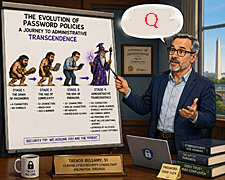
Leading cybersecurity consultant Trevor Bellamy, 51, of Arlington, Virginia, said password policies evolved gradually before achieving what experts call “administrative transcendence.”
“Most security systems now operate on the principle that legitimate users are the greatest threat,” Bellamy explained. “Hackers occasionally get in. Actual account owners almost never do.”
The report recommends simplifying password requirements, though experts concede this proposal is unlikely to gain traction.
At press time, millions of Americans were clicking the “Forgot Password?” link for the fourth consecutive time while confidently assuring themselves they would definitely remember the next one. Humanity remains optimistic in ways that cannot be medically explained.
It is not always flattering What AI Thinks About People.
Want more digital blasphemy? Fill your boots at technological mayhem.