
Hospital Asks ER Patients to Describe Symptoms Using Metaphors
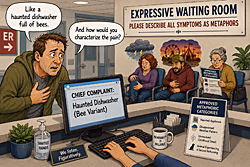
The Brandywine Regional Medical Center has launched its new Expressive Emergency Room, a program requiring all incoming ER patients to describe their symptoms using metaphors, similes, or “emotionally resonant figurative language.”
According to a hospital internal memo, the initiative aims to “enhance diagnostic nuance by encouraging patients to articulate discomfort through creative self‑expression.”
The memo further states that traditional symptom descriptions have become “overly literal,” creating what leadership calls “a bottleneck in the storytelling pipeline.”
Upon arrival at the ER, patients are handed a laminated card titled Approved Metaphoric Categories, which includes options such as “haunted appliance,” “disappointed weather pattern,” “unresolved childhood smell,” and “animal experiencing a second rehoming.” Staff is instructed to redirect any patient who attempts to use concrete language.
“We are not eliminating clarity,” said Chief Experience Officer Dr. Elaine Rupp. “We are simply reframing clarity as a collaborative art form. Chest pain is not a metaphor, but administration insists it can be.”
Triage nurses say the rollout has been challenging.
“I had a man tell me his abdomen felt like ‘a dishwasher possessed by the ghost of a raccoon who died with regrets,’” said nurse Lila Mendoza. “I wrote it down. I don’t know what else I was supposed to do.”
Hospital spokesperson Grant Weller defended the program, noting that early data shows “a 17 percent increase in narrative cohesion” and “a measurable improvement in patient‑provider vibe alignment.”
“We believe metaphor invites vulnerability,” Weller said. “And vulnerability is billable.”
Not all patients are enthusiastic. “I came in because my knee hurts,” said 62‑year‑old Harold Carson. “They told me to describe it as a weather event. I said ‘cold front.’ They said that was too literal.”
A separate “Interpretive Listening Team” has been assembled to translate metaphors into actionable notes for clinicians. The team consists of two English majors, a former community‑theater director, and a hospital volunteer who “just has a knack for symbolism.”
Despite criticism, administrators say the program will expand next quarter. A companion initiative, Diagnostic Haiku, is already in development.
The Pug Bus News Desk contains a curated list here of the absolute worst news that’s unfit to print.
All the red-hot news dispatches delivered red handed here. You’ll be sorry you looked.