
How Restaurants Identify Target Customers
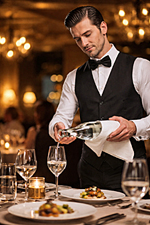
There is a moment, just after seating you, when a restaurant decides whether you are part of its intended ecosystem or an invasive species with a wallet. How restaurants identify target customers is subtle but unmistakable–not with a statement, but with a series of small, curated hurdles.
The first clue is the menu, which contains no prices because the establishment prefers to reveal them the way aristocrats revealed scandalous relatives: quietly and only when necessary.
After introducing himself the server asks, “How familiar are you with our concept?”
You thought the concept was feeding people. Amateur mistake. The real concept is making you feel as though you have shown up unprepared for an oral exam in Scandinavian vinegar.
Next you are introduced to the water. “Tonight we’re featuring a still option with remarkable minerality,” says Caleb M., a server with the posture of a man who has corrected strangers for sport. Caleb describes water like it has a résumé. It arrives with a backstory, a region, and notes of “stone fruit,” which is a troubling thing to say about something that fell out of the sky.
The entrée looks as if it has been arranged with tools commonly associated with neurosurgery. Portions are not served so much as placed, each component occupying its own emotional territory. A single scallop may sit at a distance from three lentils, as if the relationship has cooled. Any meal that appears to have been assembled during surgery is not meant for the hungry. It is meant for people who consider appetite a character flaw.
“We aim to create negative space on the plate,” explains Chef Laurent V., who trained in Paris, Copenhagen, and briefly in a silent retreat where he learned to reduce sauces until they achieved personal clarity. His signature dish, a deconstructed stew, has been described by critics as “an argument with dinner.”
The language on the menu is another tell. Nothing is cooked. It is curated, foraged, or reimagined. One does not eat here; one participates.
Physical discomfort is also part of how restaurants identify target customers. Chairs are designed to remind you that pleasure has limits. Tables are spaced to ensure you can overhear someone describing olive oil as “playful.” Lighting is calibrated to flatter the food and expose the diner.
Every dish is served on something that is not a plate. Slate tile. A cutting board. A roofing shingle. A spoon the size of a canoe paddle. The message is clear: if you came to eat off ordinary crockery like a farm animal, you have misunderstood the concept.
Substitutions are treated as philosophical errors. When one diner requested fries, she was gently informed that the chef “does not engage with that form.” She later received charred fennel and a look that suggested growth was possible if she applied herself.
Dessert arrives as a test. Olive oil cake with sea salt and an herb that has never experienced joy.
“Sweetness is a conversation,” said Marla K., a consultant who flew in for the weekend and speaks only in conclusions. Marla believes sugar is “overly literal.”
Other clues that a restaurant is judging you include butter served in a dish shaped like geology. Napkins with the absorbency of tracing paper. Staff dressed like minimalist undertakers. A bathroom that looks like a Nordic guilt exhibit.
The average check, according to numbers that feel true, is $346 per person, not including the emotional surcharge. Most diners report a lingering sense that they have failed a course they did not know they were taking.
This is how a restaurant tells you it is not for you. Not with a sign, but with a performance. The food is secondary. The message is primary: this was an experience, and you were present for it, though not actually included.
Choose from the rest of the food news menu here.