New Law Requires Citizens to Provide Proof of Life Annually
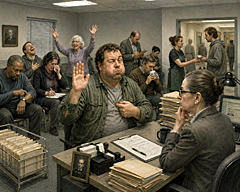
Under the terms of the Continuity Assurance Act, all adult United States residents must now report annually to an online Personal Verification Clinic (PVC) to provide official proof of life.
“We are in danger of becoming a nation of zombies,” said PVC official Marjorie Penn, 62, a municipal archivist who labels her leftovers with full accession numbers.
“Life has become increasingly difficult to distinguish from routine participation,” Penn explained. “Many Americans continue paying bills, forwarding emails, and posting vacation photographs long after exhibiting any measurable signs of vitality.”
Anyone unable to provide satisfactory proof of life will no longer be formally recognized by the federal government. Such individuals will receive no mail, no jury summonses, no access to 911, no algorithmic diet recommendations, and no invitations to complete customer satisfaction surveys.
Applicants will demonstrate proof of life through a standardized sequence of calibrated prompts, including blinking spontaneously, laughing at an unexpected remark, recalling an embarrassing childhood memory, identifying which of three chairs they would instinctively sit in, and explaining why they entered the room before forgetting halfway through.
Officials stress there are no right answers, only sufficiently human ones.
“My mentally challenged cousin could ace those questions,” laughed Darius Holt, 41, a forklift operator from Ann Arbor, Michigan. Darius, who claims that he has been “mostly alive” since 2009, was once nearly flagged for ambiguous vitality.
“I think that was the second time I voted for Trump,” he says.Applicants who fail may appeal by presenting notarized testimony from two witnesses who remember them, preferably from different decades. Witnesses must certify that the applicant was “present, contiguous, and plausibly human,” while recalling at least one specific occasion on which the individual displayed recognizable curiosity, mild regret, or an unsolicited opinion about sandwich construction.
Federal investigators say a thriving black market has already emerged for counterfeit proof-of-life certificates. Eun-Ji Park, 29, a computer programmer, warned that many convincing forgeries are printed on unusually heavy cardstock and “smell just enough like toner to inspire confidence.”
Citizens unwilling to purchase fraudulent documentation may instead enroll in a federally licensed Real-Life Rehabilitation Center, known informally as a Re-Life Rehab. Patients undergo guided breathing sessions designed to “reinflate the self,” mandatory small talk with state-certified baristas, supervised waiting in slow grocery checkout lines, and carefully scheduled naps intended to restore a functional relationship with linear time.
Graduates receive a Provisional Life Token valid for 90 days, or until they voluntarily attend a networking event.
Leonard Voss, 54, a substitute math teacher who carries a laminated hall pass for emotional support, recently completed the program.
“I feel substantially more real,” Voss reported. “Yesterday I got annoyed waiting for someone to back into a parking space. They told me that was a very encouraging milestone.”
The Pug Bus News Desk contains a curated list here of the best of the worst news that’s unfit to print.