Ten Worst Norman Rockwell Paintings
Norman Rockwell, that gentle purveyor of impossible nostalgia, gave us hundreds of paintings during his career. Most of them depicted a version of America that never existed–where milkmen smiled, doctors were patient, and children were perpetually rosy-cheeked instead of feral. Yet even by Rockwell’s standards of relentless wholesomeness, some paintings stand out as particularly egregious crimes against art. Here are the ten worst.
10. “The Gossips” (1948)
Fifteen faces repeating the same rumor in a telephone-game circle. Rockwell apparently thought, “What if I painted the same three people five times each but slightly squintier?” The result looks less like a commentary on small-town life and more like a bug in the Matrix. By face number eleven, you start wondering if Rockwell was being held hostage and this was his cry for help.
9. “Girl at Mirror” (1954)
A young girl compares herself to a magazine photo of Jane Russell while her doll lies discarded on the floor. It’s meant to be poignant. Instead, it looks like the origin story of a supervillain. That doll? Definitely haunted. The expression on the girl’s face suggests she is about to start her journey toward becoming an evil stepmother. The mirror is not showing her reflection–it is showing her future.
8. “The Runaway” (1958)
A small boy sits at a diner counter next to a state trooper, presumably after attempting to run away from home. The cop has this knowing smirk, the boy looks sheepish, and the counterman leans in with avuncular concern. It is all very heartwarming until you realize this is actually a depiction of a police state where you cannot even successfully run away as a child. Big Brother is watching, kid. And he is buying you a hot fudge sundae to make you complicit in your own surveillance.
7. “The Problem We All Live With” (1963)
Wait, this one is actually good and important. Sorry. I got confused. Moving on.
7 (Revised). “Breaking Home Ties” (1954)
A father and son wait at a train station, the son heading off to college. The father wears work clothes and stares into the middle distance with profound sadness while the son clutches his textbooks and dreams of escape. This painting is emotionally devastating, which means it absolutely does not belong in the Rockwell canon. Norman, we came here to feel vaguely pleasant about apple pie, not to confront the inevitable dissolution of familial bonds and the march of generational change. Take it back.
6. “Saying Grace” (1951)
An elderly woman and young boy pray at a crowded railway station restaurant while rough-looking men look on. It is supposed to illustrate the quiet dignity of faith, but instead it raises disturbing questions. Why is everyone in this restaurant staring at them? Are they praying at everyone or just conspicuously at this restaurant specifically? Is this psychological warfare? The longer you look, the more it resembles a hostage situation where prayer is the ransom demand.
5. “The Discovery” (1956)
A young boy finds his Santa suit hidden in his father’s dresser drawer. The existential crisis on this kid’s face could power a small European film festival. But here is what really makes this painting terrible: Rockwell expects us to believe that any father in America would fold a Santa suit that neatly. That suit would be wadded up in the back of a closet behind a broken tennis racket and a box of tax returns from 1947. The neat folding is the real fantasy here, not Santa.
4. “The Babysitter” (1947)
A frazzled teenage babysitter juggles a phone call while chaos erupts around her–kids pulling her hair, a dog stealing food, general mayhem abounds. This is not a painting; it is a warning from the Department of Homeland Security about the dangers of babysitting. The terror in that girl’s eyes suggests she is not dealing with normal children but with some kind of shapeshifting demons. And honestly? The composition is so busy that looking at it feels like having a panic attack in slow motion.
3. “The Marriage License” (1955)
A young couple applies for their marriage license at a clerk’s office. Sweet, right? Wrong. Look at that clerk’s face. Really look at it. That man has seen things. He has processed approximately 8,000 marriage licenses and he knows–HE KNOWS–that at least 7,400 of those marriages ended in bitter recrimination and arguments about who gets the gravy boat. He is trying to warn this couple with his eyes, but they are not listening. This painting is actually a horror movie in a single frame.
2. “Triple Self-Portrait” (1960)
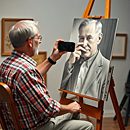
Rockwell paints himself painting himself in a mirror, with previous self-portraits pinned to the canvas. It’s meant to be clever and meta, but it is actually just Rockwell screaming into the void: “DO YOU SEE ME? DO YOU UNDERSTAND THAT I EXIST?” The self-portraits pinned to the canvas include Dürer, Rembrandt, and Picasso–because nothing says “confidence” like having to remind everyone that other people have also painted self-portraits. Also, the version on the canvas looks better than the “real” Rockwell in the mirror, which suggests this entire painting is a lie. We cannot trust anything anymore.
1. “Freedom from Want” (1943)
The absolute worst. Grandma brings an enormous turkey to a table full of gleaming, prosperous white people who look like they have never experienced a single hardship. This painting has become so iconic that we forget how deeply, profoundly weird it is. Why is everyone so happy? Where is the uncle who drinks too much and argues about politics? Where is the burnt stuffing? Where is the passive-aggressive aunt who keeps asking why you are still single? This is not Thanksgiving–this is a Norman Rockwell fever dream, and frankly, it is un-American. Real Thanksgiving involves chaos, minor injuries from opening the cranberry can, and at least one person crying in the bathroom. This painting presents a version of family gathering so sanitized it might as well be set on Jupiter. It is propaganda. It is a lie. It is the worst thing Norman Rockwell ever painted, and I will not be taking questions at this time.
Norman Rockwell’s paintings hang in museums across America, teaching future generations that their own messy, complicated, beautiful lives will never measure up to a fantasy created by a man who probably ate dinner alone in his studio most nights, surrounded by sketches of people who did not exist, slowly going mad from the weight of manufacturing joy.
For more red-hot dispatches from a culture in decline, click here and run for cover.