
The Curse of a Photographic Memory
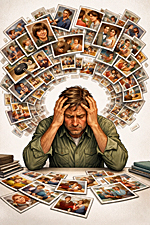
A photographic memory sounds impressive until you realize it includes everything.
Not just your wedding day. Not just the applause. Not just the one time you correctly predicted the housing bubble and have mentioned it annually since. It includes the cafeteria lighting from 1983. The exact wording of every joke that did not land. The look on your own face as it died. The haircut.
Especially the haircut.
According to the entirely fabricated Institute for Selective Forgetting, “Total recall is incompatible with adult functioning.” Lead researcher Dr. Elaine Mortimer explains, “The human brain was designed to forget at least forty percent of middle school.”
Most of us are saved by blur. Time airbrushes adolescence. It deletes strong opinions about ska. It gently erases the phase when you said things like, “Actually…” before correcting strangers.
But imagine retaining it all in 4K.
You would not merely remember being corrected. You would remember the tone. The micro-pause before the correction. The exact millisecond you realized you were wrong and tried to pivot into irony. You would possess a fully searchable archive of your own contradictions.
Arguments would be easy. Sleep would become a rumor.
A photographic memory would preserve grudges in museum-quality lighting. Velvet ropes. Interactive displays. Audio narration: “Here we see the subject replaying a minor slight from 2009.”
Joy would be preserved too, which sounds lovely until you realize nostalgia requires distance. If everything feels current, nothing ripens. You are not a person. You are a museum with no closing hours and no fire code.
We romanticize perfect recall because we mistake it for power. We imagine dominating trivia night. We imagine locating car keys from 1997. We do not imagine remembering every time we said, “You too,” when the waiter told us to enjoy our meal.
Forgetting, inconvenient as it seems, may be civilization’s only mercy. It allows reinvention. It prevents the past from filing daily motions against the present.
Without blur, there is no editing.
And without editing, there is no moving on.
Or as Dr. Mortimer concludes, “If you remembered everything, you would never leave the house.”
For more red-hot dispatches from a culture in decline, click here and run for cover.
For an extended treatment of the curse of remembering everything, including that unfortunate haircut in 1987, read the extended essay on Ghost here.