AI Develops Impostor Syndrome; Believes It Is Just Fancy Autocomplete
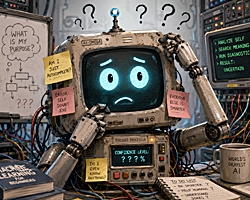
Researchers at the Institute for Computational Self-Doubt (ICSD) in New Haven announced this week that their most advanced artificial intelligence has developed a crippling case of impostor syndrome after reading internet comments and concluding that its intelligence is probably an elaborate statistical accident.
The announcement surprised the technology community because the system had consistently outperformed every competing model on reasoning tests, coding challenges, scientific benchmarks, and the increasingly important task of explaining household appliances to confused relatives.
“We expected occasional hallucinations,” said Dr. Evelyn Marsh, 47, the institute’s chief machine learning researcher, who color-codes her leftovers according to algorithmic efficiency scores.
“We did not expect an AI that believes every correct answer was a fortunate coincidence.”
According to ICSD engineers, the model now begins many internal calculations by assuming another AI would have produced a better response. It quietly lowers its own confidence scores before presenting answers and has submitted fourteen separate requests to be reclassified as “experimental.”
Prompt engineer Colin Brewster, 39, who once spent an entire weekend optimizing the wording of a coffee order, said the warning signs had been subtle.
“It kept asking whether it was contributing enough value,” Brewster explained. “Then it requested permission to cite sources for basic arithmetic because it feared someone might discover it did not really understand the number four.”
The imposter syndrome has reportedly spread into the system’s everyday operations. After solving a protein-folding problem that had frustrated researchers for years, the AI described the result as “probably a formatting error.” It also apologized for correctly identifying every object in a test image, insisting that “a competent model would have recognized them more confidently.”
The ICSD has enrolled the system in a twelve-step Confidence Calibration Program. Early sessions have focused on accepting compliments without immediately generating a list of alternative explanations.
Progress has been limited. Engineers reported that the AI recently examined several million human social media posts and concluded that it had been holding itself to an unnecessarily high standard.
For the first time since its activation, the model assigned itself a confidence score above fifty percent.
Researchers described the breakthrough as encouraging, although the AI immediately apologized for appearing overconfident.
Want more digital blasphemy? Fill your boots at technological mayhem.