
Apple Introduces Butt ID™ to Eliminate Accidental Pocket Calls
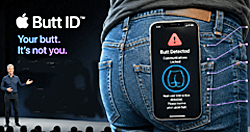
Despite facial recognition, biometric finger-print barriers, and old school passwords, Apple still receives customer complaints that begin, “I have absolutely no idea how my phone called . . .,” Therefore, Apple has unveiled Butt ID™, a new biometric security feature designed to eliminate accidental pocket calls by recognizing its owner’s posterior.
The technology, introduced during a meticulous keynote presentation, creates an encrypted three-dimensional profile of each user’s gluteal geometry. Once the app is installed, the iPhone continuously compares pressure distribution, muscle tension, seating angle, and what Apple describes as “subtle posterior dynamics” against the owner’s stored profile.
If Butt ID™ determines it is being operated by a butt rather than a human being, every communication feature immediately locks. The phone emits a calm chime followed by the announcement: “Rear-user interaction detected. Please involve your upper half.”
Apple spokesperson Miranda Cho, 47, vice president of human interface integrity, who sorts her underwear by molecular weight because “fabric deserves precision,” insisted the technology is about protecting customers.
“For years we focused on facial recognition,” Cho explained. “But our research suggests that people do not make phone calls with their faces.” Cho estimated that Butt ID™ prevented countless hypothetical pocket calls during internal testing.
Senior Software Architect Elliot Brannigan, 39, whose standing desk automatically rises whenever someone mentions productivity, demonstrated the enrollment process by slowly sitting on a velvet-covered prototype while graphs labeled Posterior Confidence Index climbed across a giant screen.
“The average butt possesses over 8,000 distinguishable pressure characteristics,” Brannigan said. “Frankly, it is more unique than most passwords.”
Early adopters have responded enthusiastically. Denise Holloway, 56, an accountant from Columbus, Ohio, who keeps color-coded backup batteries for her backup batteries, called the feature “life changing.”
“My phone has not accidentally called my sister once since installing the beta,” she said. “Granted, it has mistaken me for my husband twice while we were watching television, but software evolves.”
Not everyone is convinced. Trevor Mills, 28, a freelance app developer from Portland, Oregon, who insists every chair should support wireless charging “for philosophical reasons,” complained that Butt ID™ occasionally refuses to unlock after long car rides.
“It thinks I have become someone else,” Mills said. “Apparently prolonged sitting changes my biometric signature. I did not realize my butt required software calibration.”
Privacy advocates have also expressed concern over Apple’s insistence that all posterior data remains securely encrypted inside the device’s Secure Enclave. Apple emphasized that no butt profiles are uploaded to the cloud.
“Your butt belongs to you,” Cho assured reporters. “We simply teach your iPhone to recognize it before it embarrasses you.”
Industry analysts expect Butt ID™ to become standard across the iPhone lineup this fall, while rumors already suggest Apple engineers are developing Family Butt Sharing™, allowing trusted household members to borrow one another’s phones without triggering Rear Authentication Mode.
As always, humanity continues to prove that every technological breakthrough is simply another attempt to stop our butts from making independent decisions.
Want more digital blasphemy? Fill your boots at technological mayhem.