
Senate Brokering Deal on “Performance-Based Filibustering”
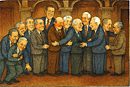
Editor’s Note:
The following dispatch is political satire. No senators engaged in interpretive gyrations, spoken-word seduction, or congressional jazz-hands as part of legislative proceedings. Probably.
Last night fourteen senators reached a fragile, history-adjacent compromise on what insiders now call “performative filibustering,” a procedural loophole previously deployed with the same enthusiasm and discretion as late-night cable programming from 1987.
The agreement clears the runway for an up-or-down vote on three of President Bush’s five delayed judicial nominees while preserving each party’s future right to filibuster by theatrical means, provided those theatrics are “contextually relevant, tastefully executed, and do not violate OSHA, C-SPAN lighting codes, or the standards of polite society, such as they currently exist.”
What Counts as “Performative Filibustering”?
Senate Parliamentarian guidance defines it as the dramatic recital of emotionally charged lyrics, hyper-suggestive Victorian prose, avant-garde mime, or unrequested interpretive movement, all intended to prolong debate indefinitely or until the national news cycle becomes bored and wanders away to sports scandals.
Sixty votes are still required to end such a filibuster. In practical terms, that means forty-one senators can now legally out-last a vote using theatrical stamina, cardio training, or pure existential spite.
Who Wanted It, Who Feared It
A coalition of Democrats, once rumored to include the late Senator Edward Kennedy, reportedly prepared to launch a full-scale dramatic reading offensive, allegedly involving everything from Broadway-style emotional monologues to jazz-club-adjacent spoken-word exhalations.
Prominent moderates insisted they “had not rehearsed any such material,” though one unnamed senator was seen in the Russell Building practicing a sultry, possibly metaphorical fan-flutter routine.
Former Vice President Darth Cheney (R-Intergalactic Sector), meanwhile, threatened a procedural maneuver widely known as the “Nuclear No-Fun Rule Change,” which would have eliminated performative filibusters entirely unless conducted fully clothed, upright, and with a policy-relevant thesis statement.
The Final Deal
The seven Democrats agreed to limit their use of theatrical filibusters to “extraordinary civic emergencies.”
The seven Republicans agreed not to vote for the rules change banning such performances.
The resulting détente was immediately praised by political scientists, constitutional scholars, and regional community-theater directors, the latter calling it “an important win for dramatic arts funding in unexpected places.”
Cultural Footnote
Performative filibustering first achieved cinematic fame in Mr. Smith Goes to Washington (1939), though historians now agree the scene was symbolic, not part of an early draft containing jazz-cabaret stamina sequences.
In unrelated diplomatic-comedy news, First Lady Laura Bush was politely but audibly booed during an open-mic set in Israel, possibly for confusing the phrase “tight five” with “tight foreign-policy talking points.”
More red-hot news dispatches delivered here. You’ll be sorry you looked.
For more red-hot news dispatches, click here. You’ll be sorry you did.